
Vail Valley
Vail, Colorado
Private Car Service & Local Guide
Where to stay, where to eat, and which part of town actually suits your trip — from the chauffeurs who drive it all season.
Vail is not one place, and booking it as though it were is the mistake that costs people a week of walking. The town runs about four miles east to west along Gore Creek, and the difference between a room in Vail Village and a room in East Vail is the difference between stepping onto a gondola in ski boots and waiting for a bus in them. What follows is the town itself — where the beds are, where the food is worth the reservation, and what the place is like once you are standing in it.
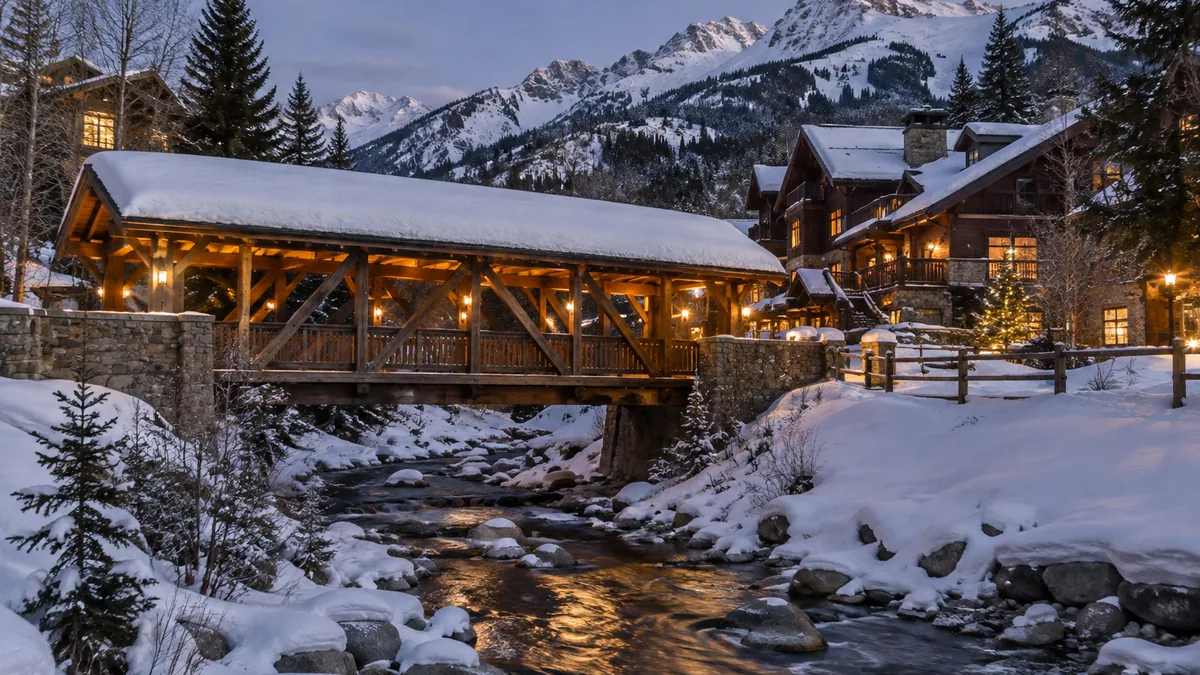
The Six Parts of Vail
The original core, at the base of Gondola One and Golden Peak. Cobbled, pedestrian-only, and the shortest walk to a lift of anywhere in town. Also the most expensive bed in the valley.
Half a mile west, built around the Eagle Bahn gondola. Newer buildings, wider sidewalks, easier for a group with kids and gear. Locals will tell you the lift line is shorter here on a powder morning.
West end, on the Cascade chairlift. Quieter, more hotel than village, and a real bus ride from dinner. Good value if you do not need to walk to a bar.
The east base, where the race and freestyle programs live. If someone in your party is in a ski school program, this is where your mornings start.
Past the interstate interchange, where the grocery store and the reasonably priced restaurants are. Street addresses, normal parking, a bus or short drive from the lifts.
Residential, up the valley toward the pass. Big houses, quiet nights, and the last place in town to get plowed after a storm.
Where to Stay
West end of Vail Village, ski concierge, and the one hotel where the valet actually solves problems. Steps from Gondola One.
Vail Village, art-heavy, with the best pool deck in town for a February afternoon and a private ski lounge at Vail Square.
Cascade Village, on its own chairlift. The family choice — bigger rooms, less cobblestone, more shuttle.
Bavarian, family-run since 1979, and the closest Vail gets to feeling European without trying to.
Golden Peak, condo-style with kitchens. If your group is six people and one of them is nine years old, book here.
Where to Eat
The reservation everyone wants, and it has held up for four decades. Book the moment your dates are firm.
Nobu Matsuhisa's mountain outpost in the Solaris building. Sit at the bar.
On-mountain, reached by gondola and snowcat, dinner only. The most memorable meal in town and the one that requires the most planning.
West Vail, where the ski patrol and the lift mechanics eat breakfast. Cash-value portions, no scene.
Ground floor of the Gasthof Gramshammer, in the middle of the village. Schnitzel, apres, and Sheika Gramshammer holding court.
Winter in Vail
Vail Mountain's front side is groomed and enormous; Sun Down and Sun Up Bowls behind it are the reason people fly across an ocean. Blue Sky Basin is another ridge back again and worth the traverse.
Top of Eagle Bahn, tubing and ski-biking after the lifts close. Non-skiers in your group finally have somewhere to be.
Groomed track five minutes from the village, rentals on site, and nobody on it at 9 a.m.
Why there is a ski town here at all
In April 1942 the Army began building Camp Hale in the Pando Valley, on a valley floor at 9,200 feet south of here, to teach soldiers to climb, ski and survive extreme cold. The 10th Mountain Division trained there. Pete Seibert came home from that division, and in 1962 he and Earl Eaton, the local prospector who found the mountain, opened a ski area above a sheep pasture on a ridge with no name. The pass, the road and the town all carry the name of Charlie Vail, the state highway engineer who routed the road through. Camp Hale became a national monument on October 12, 2022.
That history is what separates Vail from Aspen or Breckenridge: those were mining towns first and resorts second. Vail was built to be a ski town from day one, which is why the villages are walkable and why the whole valley still runs on a free bus. Camp Hale is not on the I-70 transfer; it sits on the road toward Leadville. But ask, and a chauffeur with an afternoon can take you to the foundations.
If we got one run, it would be Gitalong Road — with Riva Ridge for whoever wants it
Gitalong Road was open on Vail's first day, December 15, 1962, and it follows part of an old livestock driveway; Earl Eaton, the rancher who found this mountain's skiing potential in the first place, named it. It runs close to four miles from Mid-Vail down to the village at a grade a nervous skier can hold all the way, which makes it the rare run a family of mixed ability can genuinely do together.
That is the other reason we send groups down it. The strong skier in the party peels off onto Riva Ridge — four miles, three thousand vertical feet, named by 10th Mountain veterans for the cliff their division scaled in Italy in February 1945 — and everyone lands at the same tables in the village within a few minutes of each other. Same finish, same hot chocolate, nobody waiting at the bottom of a lift they should not have been on.
Christal’s pick, revised each season. Ask your chauffeur what the mountain is actually doing that morning.
Summer and Fall
Six weeks of orchestras in July, plus the Gerald R. Ford Amphitheater's summer concert run. Lawn seats, mountain behind the stage.
The highest botanical garden in North America, free, and a genuinely good hour at 8,200 feet.
Trailhead parking fills by 8 a.m. in July. A drop-off solves that problem entirely.
Getting to Vail
Two airports serve the valley and they produce completely different travel days. The full breakdown — mile-by-mile drive, honest winter time-adds, pass-closure behavior, vehicle fit and rates — lives on the route pages rather than being summarized here:
Vail Questions, Answered
If walking to a lift matters most, Vail Village or Lionshead. If space and value matter more, West Vail or Cascade Village and plan on the free town bus, which runs late and is genuinely good. Golden Peak if a child is in a ski program.
Not into the pedestrian core. We drop at your hotel's designated entrance or at the Vail Village or Lionshead parking structures, where the village is a short covered walk in. Cascade, West Vail and East Vail are ordinary street addresses with normal door-to-door drops.
Several Vail lodges share access roads, and a few map to the wrong side of a pedestrian mall. The property name gets your chauffeur to the right door on the first attempt; the street address sometimes does not.
Vail Village and Lionshead are, completely — no car needed for days. Everything west of the Cascade is not, and the town bus is how residents move between them. Free, and it runs until 2 a.m. in season.
Vail Village sits at 8,180 feet, Vail Pass just east of town at 10,662. That is high enough that a first day of hard skiing after a sea-level flight is a bad idea. Drink more water than you want to and give the first evening to dinner.
Yes — the whole Vail Valley. Beaver Creek has its own mountain access rules, Avon is the gondola town at its base, and Edwards is where the valley's year-round residents live. Each has its own page.
Book Your Vail Transfer
Door-to-door from DEN, EGE or anywhere on the Front Range. Flight tracked, no surge pricing.
Free QuoteExplore Nearby
Verified Operating Record
The numbers behind the promise
3,272
Completed transfers since we opened Oct 17, 2025
650,000+
Miles driven
0
Accidents
80%
Of revenue from repeat clients
We have run the mountain corridor through every major Colorado winter storm since we opened, including the days when flights stopped and the highway became Plan B. See the full operating record →
Book your Vail transfer.
Because You Matter. Professional chauffeurs, luxury vehicles, door-to-door.
Last reviewed: September 13, 2026 by Arion dispatch. Rates, policies and Colorado Department of Transportation rules are subject to change; call (970) 703-4995 for current details.