Quick Answer: If your wedding venue is anywhere west of the Front Range, this article is the most important one in our entire series.
If your wedding venue is anywhere west of the Front Range, this article is the most important one in our entire series. Transportation is the invisible framework that makes every other element of your mountain wedding possible. When it works, nobody notices. When it doesn't, it overshadows everything. The flowers, the food, the photographer, all of it.
Colorado's mountain roads are beautiful. They're also demanding, unpredictable, and dangerous for drivers who don't know them. This guide covers everything you need to know about getting your guests safely to and from a mountain wedding venue.
Understanding Colorado's Mountain Roads
The I-70 Corridor
Interstate 70 is the primary artery connecting Denver to Colorado's mountain destinations — Vail, Breckenridge, Keystone, Copper Mountain, Frisco, Dillon, and beyond. It's also one of the most congested mountain highways in North America.
Peak traffic patterns:
- Friday westbound: 2 PM – 8 PM (Denver → mountains). Traffic can add 1–3 hours to a normally 90-minute drive.
- Sunday eastbound: 1 PM – 7 PM (mountains → Denver). Same delays.
- Summer weekends: Construction season (May–October) reduces lanes and adds delays.
- Winter weekends: Ski traffic, plus weather-related closures, can make I-70 nearly impassable.
The Eisenhower Tunnel: The highest vehicular tunnel in the world (11,158 feet) is the primary bottleneck. Hazmat restrictions mean some vehicles can't use it, and accidents inside close the highway entirely.
Related reading: Colorado Wedding Transportation Checklist for Planners
Mountain Passes
Not all mountain routes are interstates. Many Colorado venues are accessed via mountain passes:
- Vail Pass (I-70, 10,662 ft) — Steep grades, winter chain requirements
- Loveland Pass (US 6, 11,990 ft) — Alternate to Eisenhower Tunnel, exposed, winding
- Independence Pass (CO 82, 12,095 ft) — Access to Aspen from the east. Closed November–May.
- Kenosha Pass (US 285, 10,001 ft) — Route to Breckenridge via Fairplay
- Red Mountain Pass (US 550, 11,018 ft) — The "Million Dollar Highway." Stunning and terrifying.
- Cottonwood Pass (CO 306, 12,126 ft) — Seasonal access to Crested Butte
The Traction Law
Colorado's traction law (HB 19-1207) requires vehicles on I-70 and other mountain highways to have adequate tires or traction devices during winter conditions. Violations result in $162+ fines and potential road closures.
What this means for wedding guests:
- Rental cars may not have appropriate tires
- Out-of-state guests may not understand the law
- Chain installation adds time and stress
- Professional transportation vehicles always comply. This alone justifies the investment
The Safety Argument
The Numbers
Colorado's mountain roads see significantly higher accident rates during:
- Winter conditions (snow, ice, low visibility)
- Night driving (limited lighting, wildlife crossings)
- Summer storms (sudden rain, hail, lightning)
- Any condition involving drivers unfamiliar with the terrain
Altitude + Alcohol
At 8,000+ feet, alcohol is more potent. One drink at altitude can feel like two. After a wedding reception with an open bar, even guests who feel "fine" may be more impaired than they realize.
There is no acceptable scenario where wedding guests drive themselves home from a mountain reception after drinking. Full stop. Professional transportation isn't a luxury. It's a moral obligation.
Related reading: Bachelorette & Bachelor Party Ideas in Colorado
Cell Service Dead Zones
Many mountain areas, including the approaches to popular wedding venues, have limited or no cell service. A guest who gets lost can't call for directions. A guest whose car breaks down can't call for help. A guest having a medical emergency can't call 911.
Professional transportation eliminates all of these scenarios. Drivers know the routes. Vehicles are maintained. Communication systems don't depend on cell towers.
Vehicle Types for Mountain Weddings
Luxury SUVs (4–6 passengers)
Best for: Bride and groom, immediate family, VIP guests
Mountain advantage: All-wheel drive, high clearance, comfortable on rough roads
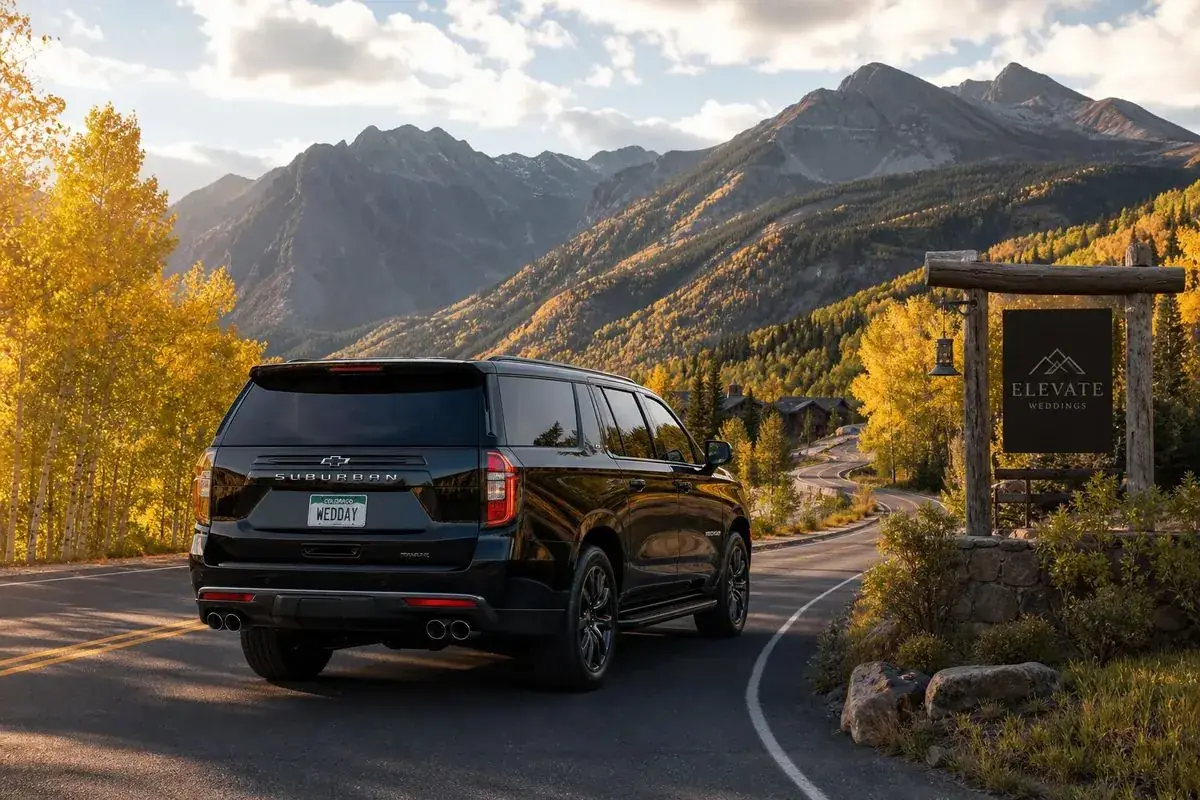
Examples: Cadillac Escalade, Lincoln Navigator, Chevrolet Suburban
Related reading: Best Colorado Wedding Cake & Dessert Artists
Sprinter Vans (8–9 passengers)
Best for: Wedding party, small groups, mid-size wedding shuttles
Mountain advantage: Professional-grade vehicle, better sightlines than a bus, comfortable for mountain drives
Use case: Wedding party transport, small-group excursions, rehearsal dinner transfers
Shuttle Buses (20–40 passengers)
Best for: Guest transportation to and from the venue
Mountain advantage: Moves large groups efficiently, reduces the number of vehicles on mountain roads
Consideration: Not all mountain access roads can accommodate full-size buses. Confirm vehicle size limits with your venue.
Motor Coaches (40–57 passengers)
Best for: Large weddings, long-distance group transfers (e.g., Denver to Vail for the entire guest list)
Mountain advantage: Highway-capable, comfortable for longer drives
Consideration: Access road limitations at many mountain venues
Building the Mountain Transportation Plan
Step 1: Map the Movements
List every group transfer that needs to happen:
- Airport → hotel(s)
- Hotel(s) → rehearsal dinner
- Rehearsal dinner → hotel(s)
- Hotel(s) → ceremony venue
- Ceremony venue → reception venue (if different)
- Reception venue → hotel(s) (end of night)
- Hotel(s) → airport (departure day)
Step 2: Count the People
For each movement, how many people need to move? This determines vehicle types and quantities.
Step 3: Time the Routes
Don't trust Google Maps for mountain drive times. Add 25–50% buffer. And account for:
Related reading: Best Wedding Caterers in Denver & the Colorado Mountains
- Day of week (weekend traffic)
- Time of day (I-70 patterns)
- Season (winter adds significant time)
- Road conditions (construction, closures)
Step 4: Build in Buffers
The cardinal rule of mountain wedding transportation: everything takes longer than you think. Build 30-minute buffers at every transition point.
Step 5: Partner with Experts
This is where Arion transforms the experience. As Colorado's top luxury ground transportation company, Arion brings:
Mountain expertise:
- Drivers who know every mountain road, every alternate route, and every seasonal challenge
- Real-time monitoring of CDOT road conditions, closures, and traction law status
- Fleet vehicles that meet all traction and chain requirements year-round
- Years of experience navigating Colorado's most popular (and most challenging) wedding venues
Concierge coordination:
- Complete transportation timeline built in coordination with your wedding planner
- Real-time flight tracking for airport transfers
- Day-of communication with your planner so the transportation plan adapts as the timeline shifts
- Under 1-hour average response time for any communication
Scale and reliability:
- 150+ affiliate partners providing access to 15,000+ vehicles nationwide
- full commercial liability coverage
- high repeat client rate. Proof that couples trust them again and again
- Vehicles ranging from luxury SUVs to Sprinter vans to full shuttle buses
The concierge difference:
Arion doesn't just provide cars. They provide a transportation concierge who manages the entire logistics chain, from the first airport pickup to the last shuttle run. They anticipate problems (I-70 closure at 3 PM? They already rerouted via US 285), communicate proactively (shuttle arriving in 5 minutes, text sent to wedding party), and adapt in real time (reception running 30 minutes late? Shuttle schedule adjusted automatically).
This level of service is what separates a professional mountain wedding from a stressful one.
Emergency Planning
Every mountain wedding should have transportation emergency protocols:
- Backup vehicle — If a shuttle breaks down, what's the contingency? Arion's network ensures a replacement vehicle is always available.
- Medical emergency plan — Which hospital is nearest to the venue? How do you get there? (Answer: in Arion's vehicle, driven by someone who knows the route.)
- Weather closure plan — If a road closes during the reception, what's the alternate route home? Your transportation provider should have this mapped in advance.
- Communication plan — How does the wedding party communicate with the transportation team? Direct phone line, not dependent on cell towers.
The ROI of Mountain Wedding Transportation
The math is simple:
Without professional transportation:
Related reading: Colorado Bridal Shops & Formalwear: Where to Find Your
- 50 cars on a mountain road = 50 chances for accidents, wrong turns, parking nightmares
- Guests arrive stressed, late, frazzled
- End-of-night drives after drinking = genuine danger
- Total cost of guest rental cars + gas + parking: often $5,000+ collectively
With professional transportation (Arion):
- 2–4 vehicles, professionally driven
- Guests arrive together, relaxed, on time
- Every guest gets home safely
- Total cost: $3,000–$8,000 depending on scale
The professional option costs the couple about the same (or less) than the collective cost guests would have spent on rental cars. While being infinitely safer, more reliable, and more enjoyable.
Arion provides luxury wedding transportation across Denver and the Rocky Mountain region. Your venue might be 30 minutes from Denver or 3 hours into the San Juans — either way, the team ensures every guest arrives safely and on time. Request a quote → | (970) 703-4995
This article is part of Arion's Wedding Season series. Return to the Guide →
For the complete picture, see our The Guide to Planning a Colorado Wedding: Every Detail, Every Vendor, Every Moment.
Frequently Asked Questions
Can I book same-day Arion service?
Same-day bookings are possible based on availability, but advance reservations are recommended — especially during peak seasons. Contact Arion's team to check current availability for your date and time.
How do I plan group transportation?
Start by confirming your headcount, dates, and key activities. Arion's team can coordinate multi-vehicle logistics for groups of any size, including staggered pickups, venue-to-venue transfers, and late-night returns.
How do I handle the wedding getaway car?
Book a separate luxury sedan or SUV for your exit. Coordinate the timing with your planner so the vehicle is staged at the designated exit point. Arion can decorate the vehicle with a 'Just Married' sign if requested.
Are there parking restrictions at Colorado mountain wedding venues?
Most mountain venues have very limited parking — some have none at all. Guest shuttles aren't just convenient, they're often required by the venue. Check your venue contract for parking capacity and shuttle requirements early in the planning process.
Can Arion handle a multi-day wedding weekend?
Yes. Many Colorado weddings span 2–3 days with welcome parties, rehearsal dinners, the ceremony, and morning-after brunches. Arion coordinates all transportation across the entire weekend with a single point of contact.


